
"import and export"
9000 article(s) found

Ethiopian coffee plantation flavor taste introduction Ethiopian coffee characteristics
35% of coffee is courtyard coffee. In this coffee garden, the planting is three-dimensional distribution. Coffee sits in the lower layers, in the shade of other crops, to get the right environment to grow. Fertilizer is mainly deciduous, withered grass and animal manure. 5% of coffee is plantation coffee. This is a modern way of growing coffee. Coffee is grown in forests, but new varieties are used and mixed with other trees.

Pure Colombia Coffee Flavor Introduction Fin Manor
German imports account for 25 per cent of Colombia's total exports, which also reflects the country's excellent quality. Coffee grades are divided into three grades: Supreme (Supremo), Excellent (Excelso) and Excellent (UGQ, Unusual Good Quality). Klauss coffee in the excellent grade is exported to Germany, and Europa coffee is exported to Nordic countries. Most coffee.

Ethiopian Coffee Flavor introduces the characteristics of Ethiopian Coffee
35% of the coffee is courtyard coffee. In this kind of coffee garden, the planting is three-dimensional. Coffee is located in the lower layer and gets a suitable growth environment in the shade of other crops. Fertilizers are mainly fallen leaves, withered grass and animal manure. 5% of the coffee belongs to plantation coffee. This is a modern way of growing coffee, which is also grown in forests, but uses new varieties and works with others.

Ethiopian Coffee Flavor Flavor Manor introduces Ethiopian Coffee varieties
Washed coffee accounts for 35% of exports. Good quality washed coffee is processed with freshly picked fully ripe fruit, picked carefully and closely monitored by professionals. The picked clean coffee beans are pulped on the day of picking, then fermented, washed, dried and peeled. The humidity of processed coffee beans is kept at about 12%. Sun-cured coffee accounts for 65% of exports. Mainly by

Ethiopian coffee beans are imported. How can I buy mcofa coffee?
For more information on coffee beans, please pay attention to Coffee Workshop (Wechat official account cafe_style) Ethiopia is still a very important coffee exporter in the world, mainly producing Sidamo in Sidamo, Yirgacheffe in Yegashev, Kochere in Cochel, Harar in Hara and Djimma in Jima. Located in the south of Ethiopia, Sidamo, Yegashev,

Ethiopian coffee flavor manor area with nut flavor
In Ethiopia, the grading and quality control system of coffee is divided into three levels: producer, regional and national. All coffee is inspected by local inspection agencies before leaving the country of origin, and then re-tested at the coffee inspection and grading centers in Addis and Diredawa to determine its quality grade. Coffee is graded before auction and sale, for all involved in production, acquisition,

History of International Coffee Organization
In the 19th century, coffee became an important commodity in the international trade market. For a long time after that, the coffee market was often in a state of oversupply, low prices, and occasional price increases in short supply, but for a short period of time. During the economic crisis of the 1930s and during World War II (1939-1945), the coffee market supply

The relationship between Kenyan coffee and Arabica coffee beans
In Ethiopia, the grading and quality control system of coffee is divided into three levels: producer, regional and national. All coffee is inspected by local inspection agencies before leaving the country of origin, and then re-tested at the coffee inspection and grading centers in Addis and Diredawa to determine its quality grade. Coffee is graded before auction and sale, for all involved in production, acquisition,

The origin of Salvadoran coffee is an important factor in the high quality of Salvadoran coffee.
For the exchange of professional baristas, please pay attention to the coffee workshop (Wechat official account cafe_style) El Salvador El Salvador has good coffee growing elements: soil, altitude, climate, and the tradition of varieties has a long history: the Old World variety bourbon, and the natural mixture of bourbon, Pacas (pacas) and Kaddura (caturra).

Introduction to the Flavor characteristics of Ethiopian Yega Xuefei Coffee
In Ethiopia, the grading and quality control system of coffee is divided into three levels: producer, regional and national. All coffee is inspected by local inspection agencies before leaving the country of origin, and then re-tested at the coffee inspection and grading centers in Addis and Diredawa to determine its quality grade. Coffee is graded before auction and sale, for all involved in production, acquisition,

An introduction to the characteristics of Ethiopian Coffee Flavor Manor
In Ethiopia, the grading and quality control system of coffee is divided into three levels: producer, regional and national. All coffee is inspected by local inspection agencies before leaving the country of origin, and then re-tested at the coffee inspection and grading centers in Addis and Diredawa to determine its quality grade. Coffee is graded before auction and sale, for all involved in production, acquisition,

Acidity and texture of Ethiopian Fine Coffee Bean Flavor and Taste Manor
35% of the coffee is courtyard coffee. In this kind of coffee garden, the planting is three-dimensional. Coffee is located in the lower layer and gets a suitable growth environment in the shade of other crops. Fertilizers are mainly fallen leaves, withered grass and animal manure. 5% of the coffee belongs to plantation coffee. This is a modern way of growing coffee, which is also grown in forests, but uses new varieties and works with others.

Taiwan Sugar Coffee diplomacy proposes to set up an Office in Honduras
Professional baristas Please follow the Coffee Workshop (Wechat official account cafe_style) Honduras is the fifth largest exporter of coffee beans. Taiwan Sugar announced today that the first batch of imported Hongguo coffee beans will be sold on the Taiwan Sugar Channel by the end of the year, and an office will be set up in Honduras to deepen agricultural exchanges. Taiwan Sugar held a press conference on Honduran Coffee fragrant Treasure Island this morning and announced that it would

Introduction to the Export and sales of Colombian Coffee Lazmus Manor
Colombia is one of the most important coffee exporters in the world. According to the statistics of the International Coffee Organization, Colombian coffee exports accounted for an average of 17% of the world's total coffee exports in 1991 and 1996, second only to Brazil (24% of the world's total exports). In 1998, the total coffee exports of the member states of the organization were 79.5 million bags, of which Brazil accounted for 22.9%, Colombia 14.2% and Vietnam 8.1%.

Talk about Certification | ICO-- International Coffee Organization formulates the International Coffee Convention
125 million people around the world depend on coffee, and most of the coffee is produced by small coffee farmers, who farm so hard that the world consumes 600 billion cups of coffee a year. Large consumption makes coffee one of the widely traded commodities in the world. More than 60 countries mainly produce and trade coffee. These countries rely heavily on coffee exports. According to statistics, there are many countries.
International Coffee Organization Historical Fine Coffee Bean Organization
In the 19th century, coffee became an important commodity in the international trade market. For a long time after that, the coffee market was often in a state of oversupply, low prices, and occasional price increases in short supply, but for a short period of time. During the economic crisis of the 1930s and during World War II (1939-1945), the coffee market supply
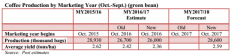
Vietnam Coffee Annual report 2017
Main points of the report Vietnam coffee production in 2016 / 17 was revised from 26.7 million bags to 26 million bags due to abnormal rainfall during the harvest season, resulting in a smaller than expected yield. The weather conditions were good in the first half of the year, with an estimated production of 28.6 million bags, an increase of 10 per cent over the 17th of 2016. The abundant rainfall from January to March makes the coffee tree send out more branches and bloom.

Yemeni Coffee
Coffee has been Yemen's traditional export product for hundreds of years and is still one of Yemen's most important cash crops and export products. Statistics show that among Yemen's top 30 exports in 2000, cooked coffee beans, raw coffee beans and coffee shells ranked second, eighth and 21st respectively, with a total value of about 17.5 million US dollars, of which raw coffee is about 12.25 million US dollars
The International Coffee Organization's historical boutique coffee organization
In the 19th century, coffee became an important commodity in the international trade market. For a long time after that, the coffee market was often in a state of oversupply, low prices, and occasional price increases in short supply, but for a short period of time. During the economic crisis of the 1930s and during World War II (1939-1945), the coffee market supply

Introduction of Ethiopian Coffee Bean varieties in Ethiopian Coffee Flavor Manor
In Ethiopia, the grading and quality control system of coffee is divided into three levels: producer, regional and national. All coffee is inspected by local inspection agencies before leaving the country of origin, and then re-tested at the coffee inspection and grading centers in Addis and Diredawa to determine its quality grade. Coffee is graded before auction and sale, for all involved in production, acquisition,